
Cala s´Almunia
Santanyí · Mallorca
 Weather in Santanyí
 The beach
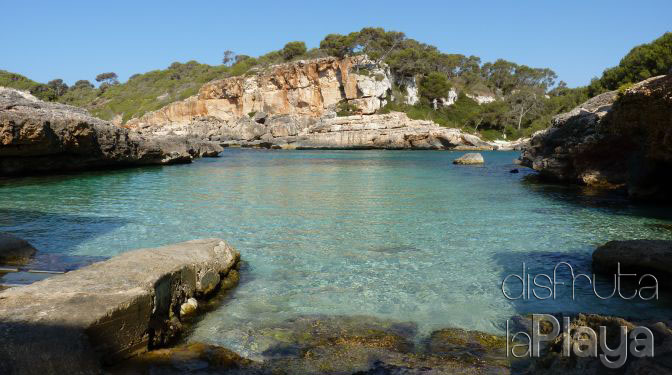
Cala s'Almunia is a sandy and rocky cove located near Cala Llombards development, Santanyí. There is a small sandy area and another one which is very beautiful and a former pier where more people go.To reach the cove you must go down a stone stairway.
Notes
From May 2017 you can not reach the urbanization of Cala S'Almonia by car, you must either park in Cala Llombards and walk (15 minutes), or access by bus from Santanyí that will leave us on the stairs of the cove . Cove with several swimming areas: Old fishermen's huts that is its greatest charm, also has a small sandy area, and a rock where there is a small cave and younger are jumping into the sea.
Restaurants
Nearby restaurants NO RESTAURANTS CLOSE TO THIS AREA
Video
 What this beach has
 Photos of Cala s´Almunia
How to get there
- 1From santanyí
Leave Santanyí driving along ma 6100 towards Colònia de San Jordi.
- 2Roundabout
We will arrive at a roundabout and take the second exit towards Cala Llombards. From June 2017 we must park in the first street when we're arriving at Cala Llombards and then continue on foot. Only about 30 vehicles can park in this street and in the rest of the urbanization there is continuous yellow line, impossible to find parking in July and August. We recommend using the bus line.
- 3Information sign
When parking, we must return by the road that reaches Cala Llombards and look for the road that is about 30 meters before reaching the sign of the urbanization of Cala Llombards. It is the road where it indicates the prohibition of entering less to the authorized ones (residents of Santanyí). We will continue walking, there are about 15 minutes up the stairs to access the coves.
- 4Path
This road is called Cala Almunia although the name is not visible. It is a two-way road and on the sides there are stone walls. We will follow to the end. There is a fork, we will continue to our left just a few meters. Then turn right onto the first street.
- 5Another bifurcation
We retrace the road in its entirety to the end where there is another fork and turn to our left to turn right again for the first one we find. A few meters away we will find two informative posters of the two coves.
- 6Stairs
The entrance to the two coves is from a long staircase leading first to Cala S'Almunia and from the fishermen's area there is access to Caló d'es Moro.
- 7Bus access
Updated information at https://www.tib.org/en/web/ctm/autobus/linia/505 You must leave the vehicle in the Son Olivó estate, on the Ma-19 road between the Lidl and the Renault there is a street, there is the stop of the line 505. Frequency every 60 minutes and it arrives until the staircase of cala s'Almonia .
Where it is
 Other beaches near Cala s´Almunia
About Santanyí
Santanyí is a Majorcan municipality that belongs to the Migjorn region. It borders on Ses Salines, Campos and Felanitx. It is famous for having very touristic coves such as Cala Mondragó and Cala d'Or as well as coastal urban nuclei like Portopetro, Cala d'Or or Cala Llombards. In Santanyí there is an important cheese and ice cream industry, most of them of artisan production. In Santanyí we can highlight its area for water sports in Portopetro, Cala Figuera and Cala d'Or or practising golf in the vicinity of Cala d'Or. The Mondragó nature reserve with its ecosystem variety can also be visited. Noteworthy in Santanyí is its cultural richness: being the most significant in architecture the 14th and 16th century Porta Murada, The Sant Andreu church from the 18th century and the remains of the talaiotic culture.
